Donut County turns physics puzzles into a comedic swallowing adventure
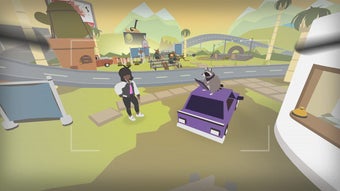
Donut County by Ben Esposito is a story-driven physics puzzle on PlayStation 4 where you control a growing hole. You move the hole around environments, consuming objects to enlarge it and progressing through short, staged puzzles that change scale as you grow. The game pairs a satirical, character-led narrative with simple mechanics, targeting casual players and families who prefer relaxed, bite-sized puzzling experiences.
The narrative treats each swallowed object as consequence
So, the setup places the player in an odd moral frame: BK, the hole-driving raccoon, swallows the town and then meets the displaced residents 999 feet underground who demand answers. Thus, the story links the puzzle loop to social consequence, using character banter and satire of gamification to propel scenes from campsites to secret laboratories while keeping stakes light rather than punitive.
The puzzle loop is compact and resolves within a few hours
The game structures progress as a series of short levels that stack into a complete arc, with a typical completion time of two to three hours. Single-player only, it culminates in a final boss encounter that applies the hole mechanics in a more action-oriented way. The PlayStation 4 build requires roughly 350 MB of save space, which reflects the game’s compact technical footprint.
Difficulty and pacing favor accessibility over mechanical depth
So, design choices keep pressure low: there are no game-over screens or timed penalties, and the controls remain simple throughout. Thus, onboarding is low-friction and the experience suits a wide age range and casual sessions. Some aspects are a little all over the place in pacing; the late-stage action beat contrasts with the earlier relaxed puzzle rhythm.
Replay value depends on charm rather than extended systems
Replayability comes from personality and short-session design rather than procedural content. The main story’s brevity reduces long-term grinding, and single-player focus means no community-driven competitive hooks. The conceit invites comparison to Katamari’s growth mechanic in reverse, placing the title among concise indie narrative experiments that prize distinct moments over hour-long play loops.
A compact, character-first puzzler best for short play sessions
A short, character-driven puzzler suits players who prefer gentle, narrative-focused sessions and light, consequence-minded mechanics. Its brevity and linear structure limit extended replay for players seeking long-term systems or multiplayer engagement. The game rewards attention to its writing and staged puzzles, making it a good pick for those who value a tidy, story-led experience over sprawling mechanical depth.